Alvor Agreement
Another Day of LifeThe Alvor Agreement was the January 1975 accord that created a provisional coalition government in Angola and set 11 November as the date for independence. Its provisions supplied a timetable for transferring power, but the agreement’s promised coalition did not hold: the transitional government began work in Luanda, then the FNLA and UNITA withdrew from it. As Portugal’s departure approached, control of the capital and the meaning of the scheduled handover became military as well as political questions.
Terms and Transitional Government
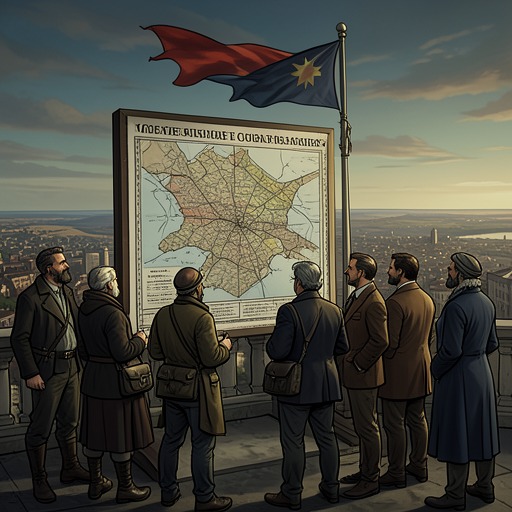
The agreement was signed at Alvor, Portugal, on 25 January 1975 by the MPLA, the FNLA, UNITA, and the Portuguese government. As the book records its terms, it established a provisional coalition government in Angola and granted the country independence on 11 November 1975. It was therefore both a political arrangement among the liberation movements and the former colonial government and a calendar for the end of Portuguese rule.
The provisional government took effect in Luanda on 30 January. Five months later, the FNLA and UNITA resigned from it. That withdrawal marked a break in the coalition contemplated at Alvor; the agreement’s timetable remained in place even as the political arrangement it had created weakened. The chronology also records bloody riots in Luanda in March: civilians who declared for the MPLA were attacked by FNLA troops. These entries show that the transition was already marked by conflict, though they do not establish the agreement as the cause of the riots.
The Withdrawal Deadline and Operation Orange
The agreement’s timetable made 10 November a decisive date. Under its terms, the last Portuguese units were to leave Angola at 18:00 that day; independence was to follow on 11 November. In the account of the South African plan called Operation Orange, occupying Luanda by the withdrawal deadline was the stated goal. The plan projected that, on independence, power would pass to an FNLA–UNITA coalition government. That was the operation’s intended outcome, not an outcome guaranteed by the agreement itself.
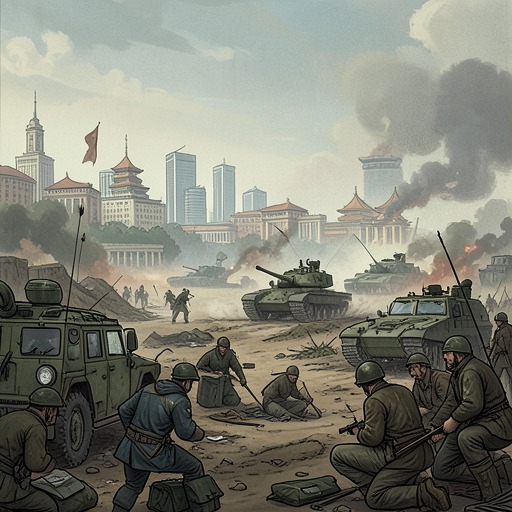
Operation Orange was designed as a three-direction advance on the capital. From the south, motorized South African Army units were to move along the Tsumeb–Pereira d’Eça–Lubango–Benguela–Novo Redondo–Luanda road, supported by Portuguese volunteers and FNLA, UNITA, and Chipenda forces. The northern advance was assigned to FNLA units, supported by forces from the Republic of Zaïre and Portuguese volunteers, along the Maquela do Zombo–Carmona–Caxito–Luanda road. An eastern column was also planned, on the Nova Lisboa–Quibala–Dondo–Luanda route, with the same support described for the north.
Planners disagreed over when to begin. One side urged an earlier start to allow for resistance and the lengthening supply lines needed to carry ammunition, fuel, and food. Others expected a rapid advance and argued that the northern forces were already near Luanda. The cautious proposal prevailed, but its selected zero hour was Sunday, 19 October—before the agreement’s November deadline. The account then describes Comandante Farrusco and his driver encountering an advancing column of armoured vehicles and a helicopter; Farrusco was badly wounded and the driver took him away. The episode makes the deadline’s military pressure concrete without implying that the agreement itself directed the operation.
A Formal Handover Under Siege
As the deadline neared, the timetable collided with the uncertain control of Luanda. On 4 November, the narrator reports that assistance was expected from Brazzaville and Cabinda but could not reach the city while the airport and harbour remained in the hands of the Portuguese army. Until 10 November, Angola was formally a Portuguese overseas province and, in the account, part of NATO territory. The MPLA leadership therefore faced a practical problem of access as well as a question of political legitimacy: the capital was surrounded by land and could not be reached by sea or air, while rumours and missing information about the southern front fed panic.
The city’s wider unravelling provides the setting for that struggle, rather than a clause of the agreement. Portuguese residents from across Angola converged on Luanda, many eventually gathering around the airport as they waited for flights out. The airport became an improvised encampment, and disputes over who should board intensified as people sought places on planes. By early October, water was running short because pumping stations lay on the front lines and repairs were repeatedly undone by fighting. When the police left, the remaining residents faced the loss of another public institution; the departure of the garbage workers was followed by mounting refuse, with few services left open. These details locate the scheduled transfer within a city where ordinary administration and basic services were failing.
Independence and the Agreement’s Limits
At midnight on 11 November, after the cathedral clock struck twelve, Agostinho Neto read a proclamation establishing the People’s Republic of Angola. The square was dark and crowded; his voice broke and he paused several times. Applause and cheers followed, then the platform lights went out and people departed through the darkness. Artillery on the northern front was silent, while soldiers in town fired into the air in celebration. Independence thus arrived on the date stipulated at Alvor, but the account presents the moment not as a settled transfer to the coalition envisioned in Operation Orange, but as a proclamation by Agostinho Neto amid continuing military uncertainty.
The agreement’s significance lies in the tension between a negotiated schedule and the struggle to make that schedule govern events. It set out a provisional coalition and a date for independence; the coalition fractured, rival forces planned to seize the capital, and control of the airport and harbour affected who could reach it. The 11 November proclamation fulfilled the stated independence date, but the scenes surrounding it—restricted access, exhausted residents, and an uneasy celebration—show the limits of a formal timetable when the institutions and political cooperation needed to carry it out had broken down.